[OnePiece] The Secrets Behind One Piece Supernova Names: How Much Do Kid, Law, and Bonney Resemble Real Pirates?
When watching One Piece, even the pirates’ names can catch your attention. Eustass Kid, Trafalgar Law, Jewelry Bonney, and Marshall D. Teach initially sound like names invented for a manga. Yet open a history of real pirates, and familiar names reappear. Some characters combine the names of two pirates, while another even borrows the name of a Mafia boss.
The origins of One Piece’s Supernova names are more than fan speculation. In the SBS section of Volume 52, Eiichiro Oda confirmed that several Supernovas were named after real pirates. Sharing a name, however, does not mean that their personalities, abilities, or eventual fates were copied as well. Here, I’ll examine the confirmed name origins and historical facts, then separately explore the similarities with their fictional counterparts.
1. Were the One Piece Supernovas Named After Real Pirates?
The answer is yes: several Supernovas take their names from historical pirates. In Volume 52’s SBS, Oda answered a reader’s question about the origins of Kid, Law, Drake, Bonney, Apoo, Urouge, and others. For Capone Bege in particular, he corrected the reader’s guess and identified the actual source of the name.
First, we need to distinguish the Supernovas from the Worst Generation. The eleven Supernovas who attracted attention at the Sabaody Archipelago are Luffy, Zoro, Kid, Killer, Law, Hawkins, Drake, Apoo, Bonney, Bege, and Urouge. Add Blackbeard, Marshall D. Teach, and these twelve are known as the Worst Generation. Describing Blackbeard as one of Sabaody’s eleven Supernovas therefore gets the roster wrong from the start.
That does not mean all eleven names should be linked to historical pirates. In the same SBS, Oda did not identify a separate historical namesake for Killer. Basil Hawkins combines the names of John Hawkins and Basil Ringrose, but Luffy and Zoro cannot simply be explained through the same naming pattern as the pirates discussed here.
This is where the names become interesting. Real pirates were more than the popular image of free-spirited adventurers: they could also be plunderers, mercenaries, and collaborators with states. One Piece’s new generation of pirates likewise pursues different goals through different methods. Knowing the history behind their names makes it clearer how many different kinds of people gather beneath the same label: pirate.
2. Why Does Eustass Kid’s Name Combine Two Pirates?
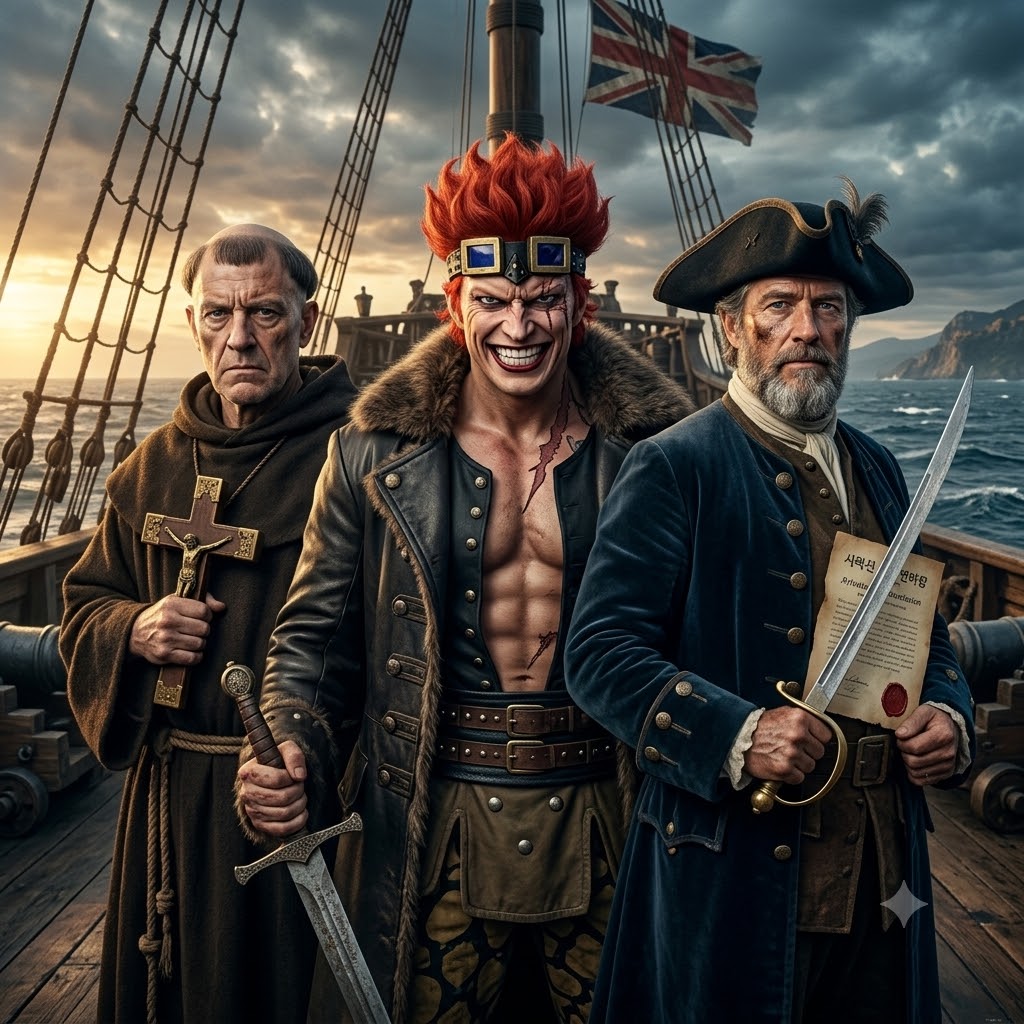
Eustass Kid’s name comes from Eustace the Monk and William Kidd. What makes this interesting is that these two men were not fellow pirates living in the same period. Eustace the Monk was a medieval figure, while William Kidd operated several centuries later.
Eustace the Monk is known as a pirate and mercenary with a religious background. He took part in the power struggles between England and France, conducted military operations at sea, and met his end at the Battle of Sandwich in 1217. His life offers no tidy separation between personal violence and warfare on behalf of a state. Fighting for a king did not always guarantee a secure position.
William Kidd, too, did not begin simply as a raider with no connection to a state. He operated under a privateering commission, but was eventually tried for piracy and murder and executed in 1701. We should be cautious about portraying him solely as an innocent victim. Alongside the political interests of the time, the legality of his actual ship captures was also at issue.
One Piece’s Kid brings fierce ambition and dangerous alliances to mind. He tries to reach the top through his own strength, yet joining forces with others exposes him to betrayal and the dangers of power. I find it interesting to read Kid’s actions alongside these two historical names. Oda, however, has not stated that this was precisely why he combined them.
3. Why Trafalgar Law’s Name Evokes a Naval Battle, Waterloo, and Edward Low
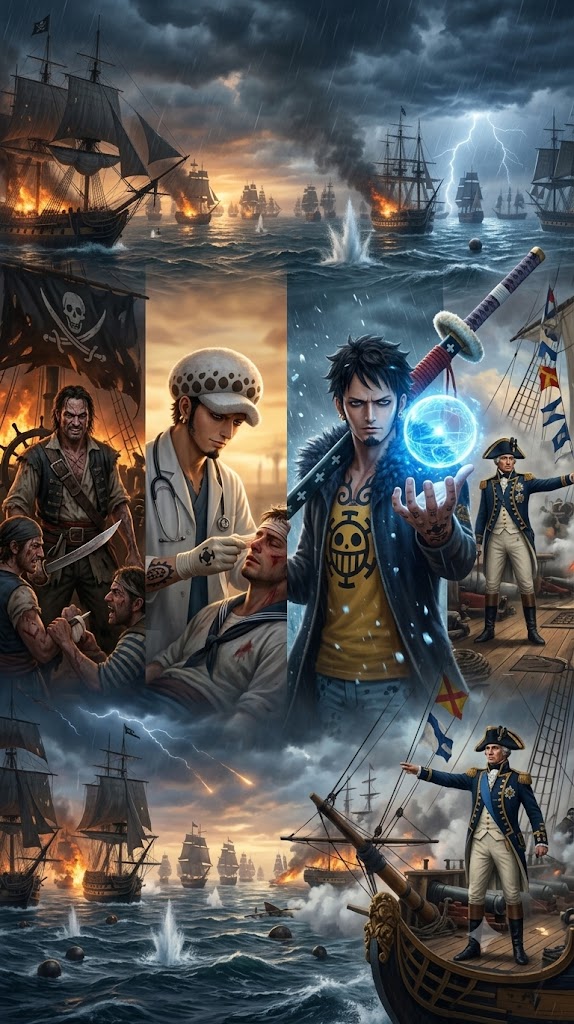
Trafalgar Law’s name contains elements that evoke different histories. The historical pirate behind “Law” is Edward Low. Low was notorious for his cruelty, whereas Law saves people through medicine. Borrowing a name does not make them the same kind of person. The name connection is confirmed in Volume 52’s SBS, but the symbolic interpretation involving Trafalgar and Waterloo needs to be considered separately.
Law’s full name is Trafalgar D. Water Law. “Trafalgar” evokes the Battle of Trafalgar, while the Japanese rendering of “Water Law” can be read as a connection to Waterloo. Fans have consequently interpreted his name alongside two important defeats associated with Napoleon. Recognizing a linguistic connection is different from proving the author’s intention behind a particular scene.
At the Battle of Trafalgar in 1805, the British fleet commanded by Horatio Nelson defeated the combined French and Spanish fleet. Britain won, but Nelson died from a gunshot wound sustained during the battle. At Waterloo in 1815, Napoleon was defeated by the allied forces of Wellington and Blücher. A naval victory, a commander’s death, and an empire’s final defeat thus gather around a single name.
Knowing this background makes Law’s confrontation with Big Mom more intriguing. One of Big Mom’s Homies is named Napoleon. There is room to read Law and Kid’s joint defeat of Big Mom alongside Napoleon’s defeats. But we cannot present this as an officially confirmed blueprint for the story’s outcome.
4. Was X Drake’s Namesake Francis Drake a Pirate or an English Hero?
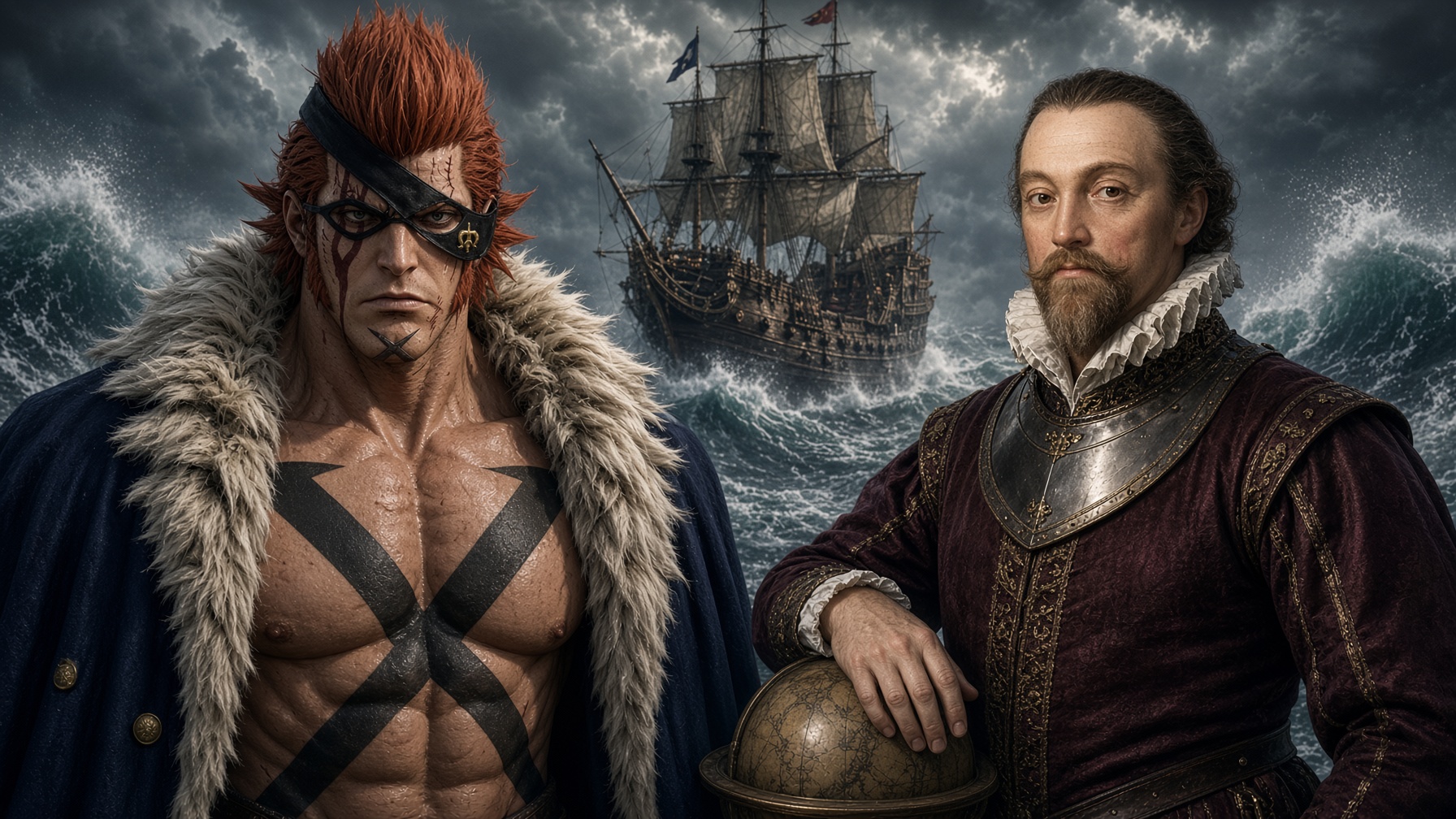
X Drake takes his name from Francis Drake. Francis Drake was a sixteenth-century English navigator, privateer, and naval commander. He completed a circumnavigation of the world and also took part in the war against the Spanish Armada. English history remembers him as a hero, but those he attacked could also see him as a plunderer.
To understand this difference, we need to understand privateering. A privateer was a privately operated armed vessel authorized by a state to attack an enemy country’s ships. Such activity benefited the state issuing the commission, but that authorization offered little comfort to people who lost their ships and property. This explains why Francis Drake can be described as both a pirate and a hero.
In One Piece, X Drake is initially known as a former Marine turned pirate, before his connection to SWORD is revealed. The difference between his outward identity and his actual affiliation recalls Francis Drake’s position on the boundary between state service and piracy. This gives us something worth comparing beyond a similar name.
Still, a privateer captain and a Marine carrying out a secret mission are not the same profession. Their methods differ. What interests me is the underlying pattern: the same person can receive different labels depending on the position of law and power. X Drake’s name reinforces the difficulty of judging someone’s true identity simply from the pirate label.
5. How Much Does Jewelry Bonney Resemble the Female Pirate Anne Bonny?

Jewelry Bonney takes her name from Anne Bonny. There is no established basis for claiming that “Jewelry” also comes from Anne Bonny’s nickname or from the theft of jewels. The confirmed connection is the name Bonney; other elements require separate evidence.
Anne Bonny was a female pirate who joined John Rackam’s crew in the eighteenth-century Caribbean. She is often discussed alongside Mary Read and was tried for piracy in Jamaica in 1720. Records indicate that her execution was postponed because she was pregnant, but accounts of her later life and eventual fate vary. A famous anecdote is not necessarily a firmly established historical fact.
Bonney in One Piece also acts according to her own wishes in a sea filled with male pirates. She does not meekly obey others’ orders and, when necessary, confronts authority directly. This is where I sense the rebellious impression created by the name Anne Bonny.
But directly mapping Anne Bonny’s romances or pregnancy onto Jewelry Bonney’s story would be a stretch. Bonney’s fictional story centers on her family relationship with Kuma, her childhood wounds, and the powers that oppressed her and her family. Its starting point is too different to treat it as the same story as the historical female pirate’s life.
6. Who Was the Chinese Pirate Behind Scratchmen Apoo’s Name?
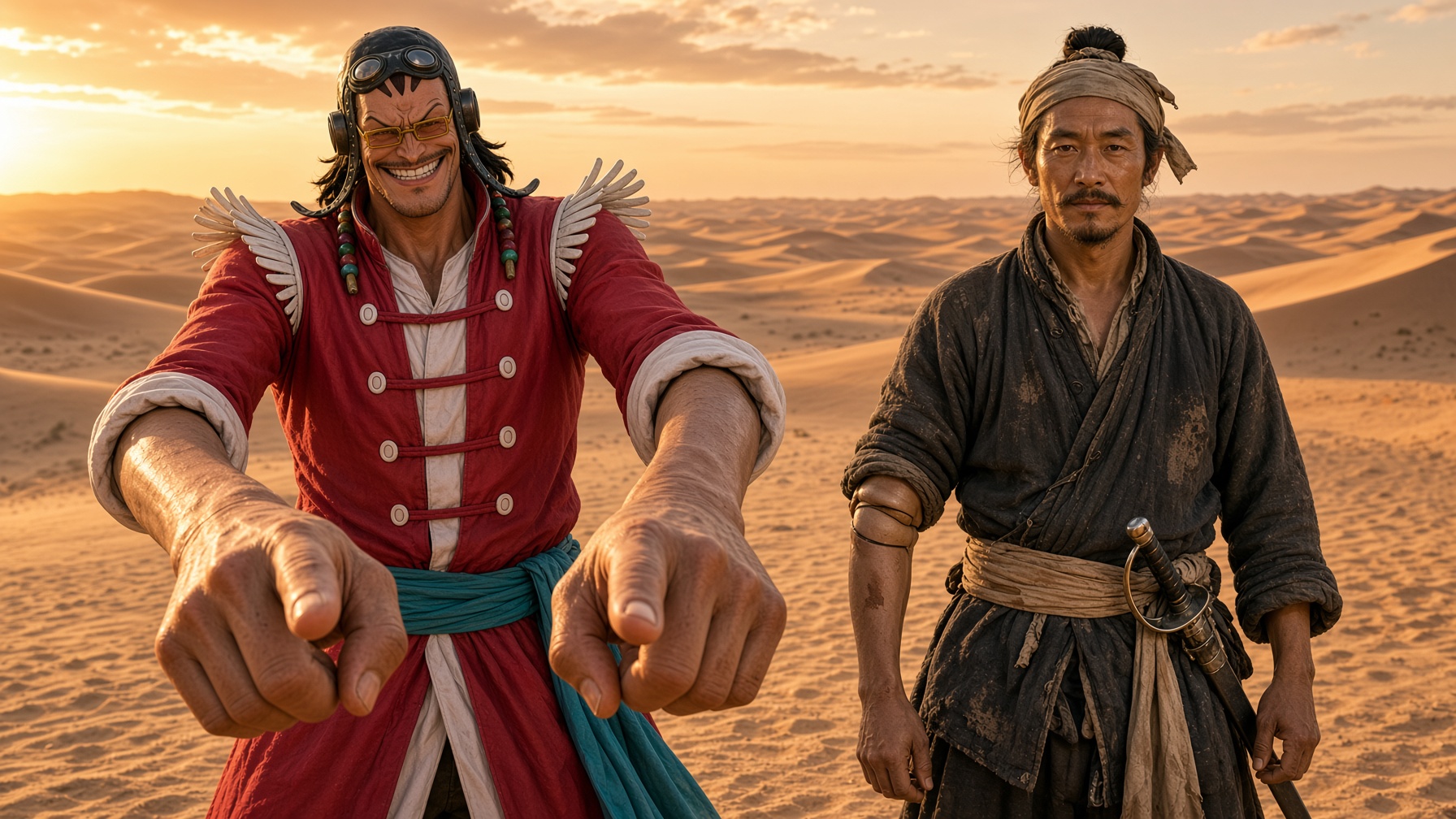
Scratchmen Apoo takes his name from the Chinese pirate Chui A-poo, written 徐亞保 in Chinese. Korean sources may render the name as Seo A-bo or use other transliterations, but the namesake discussed here is the same person. We should not mix the life of another famous Chinese pirate into an account of Apoo’s historical model.
Chui A-poo operated in the South China Sea during the nineteenth-century Qing period. Based around Hong Kong, he commanded a substantial fleet, but his power collapsed following attacks by the British navy and others in 1849. His is a name we are unlikely to encounter if we think only of eighteenth-century Caribbean pirates. The historical worlds drawn into One Piece’s names extend beyond Europe and the Atlantic.
Apoo’s Chinese-inspired clothing makes the connection with an East Asian pirate feel natural. However, there is no basis for claiming that his Longarm Tribe anatomy or his ability to turn sound into a weapon came from Chui A-poo’s characteristics. The explanation that his musical powers were added because the real Chui A-poo was a musician is likewise unconfirmed.
When I think of Apoo, information, bargaining, and betrayal come to mind first. His choices in the alliance involving Kid and Hawkins can make it tempting to imagine that his namesake was the same kind of traitor. But projecting a fictional character’s actions backward onto a real person amounts to inventing history.
7. Baba Oruç: The Barbary Corsair Behind “Mad Monk” Urouge’s Name
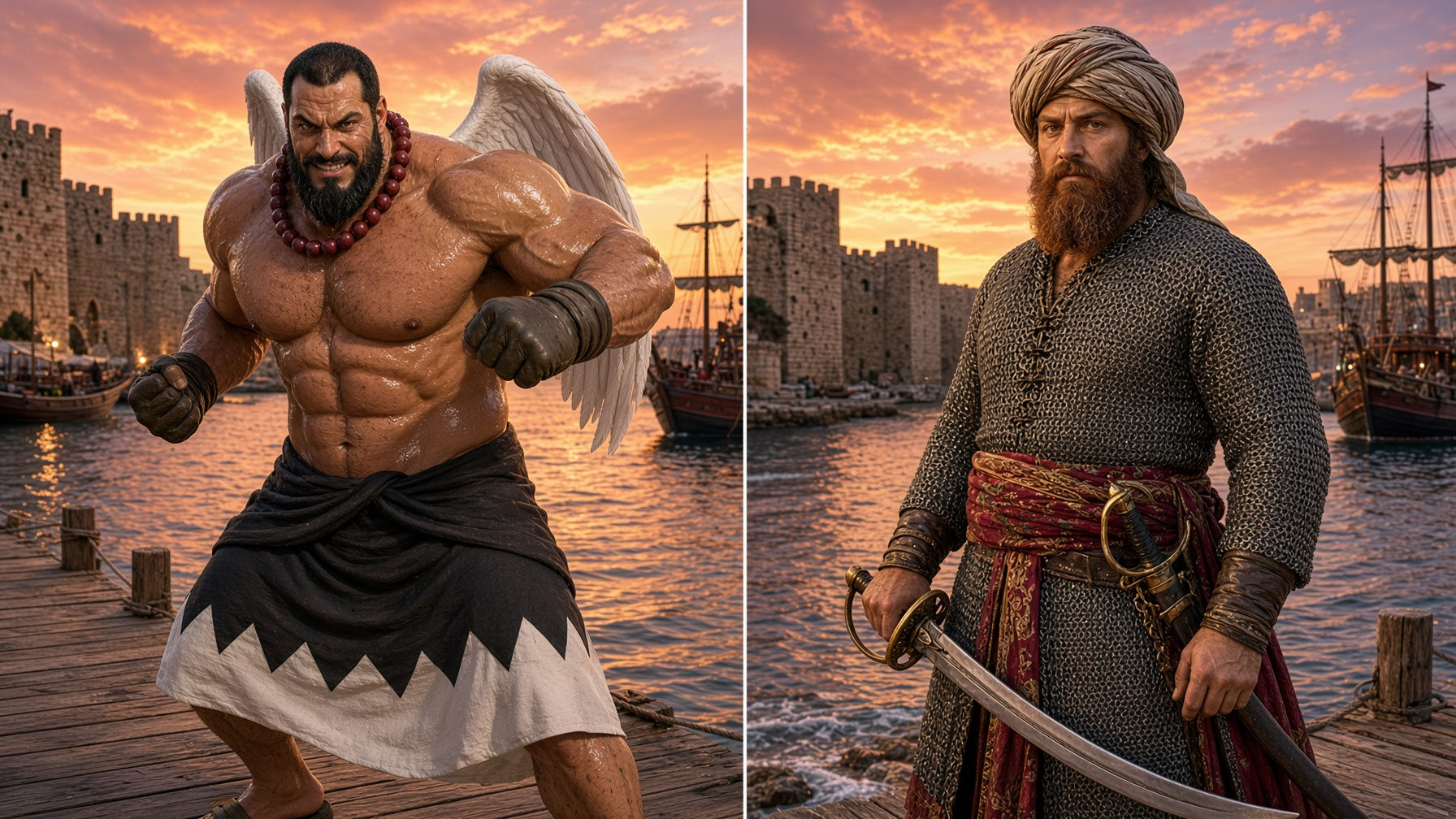
“Mad Monk” Urouge takes his name from Oruç Reis. This figure also appears under names such as Baba Oruç and Aruj Barbarossa. When comparing the Korean spellings used for Urouge and his namesake, it is more important to identify the person being discussed than to focus solely on the transliteration.
Oruç Reis was a pirate and military leader active in the Mediterranean from the late fifteenth to the early sixteenth century. Alongside his brother Hayreddin, he played a role in North Africa’s political and military changes. “Barbary pirates” is not the name of a single individual, but a broad term for pirate and privateering forces along the North African coast. The actions of Oruç and those of his brother also need to be distinguished.
His life included clashes with Spain, the seizure of power around Algiers, and a battle injury that cost him an arm. In some respects, he was closer to a ruler with territory and military strength than to a pirate who simply plundered and disappeared. Assessments of him can also change depending on whose records we read.
Urouge’s monk-like appearance in One Piece should not lead us to assume that Oruç Reis was a Buddhist monk. The historical namesake and the character’s “Mad Monk” image are separate elements. Transferring the background of Eustace the Monk to Urouge would likewise confuse two different historical models.
8. Why Does Capone Bege Combine the Names of a Pirate and a Mafia Boss?
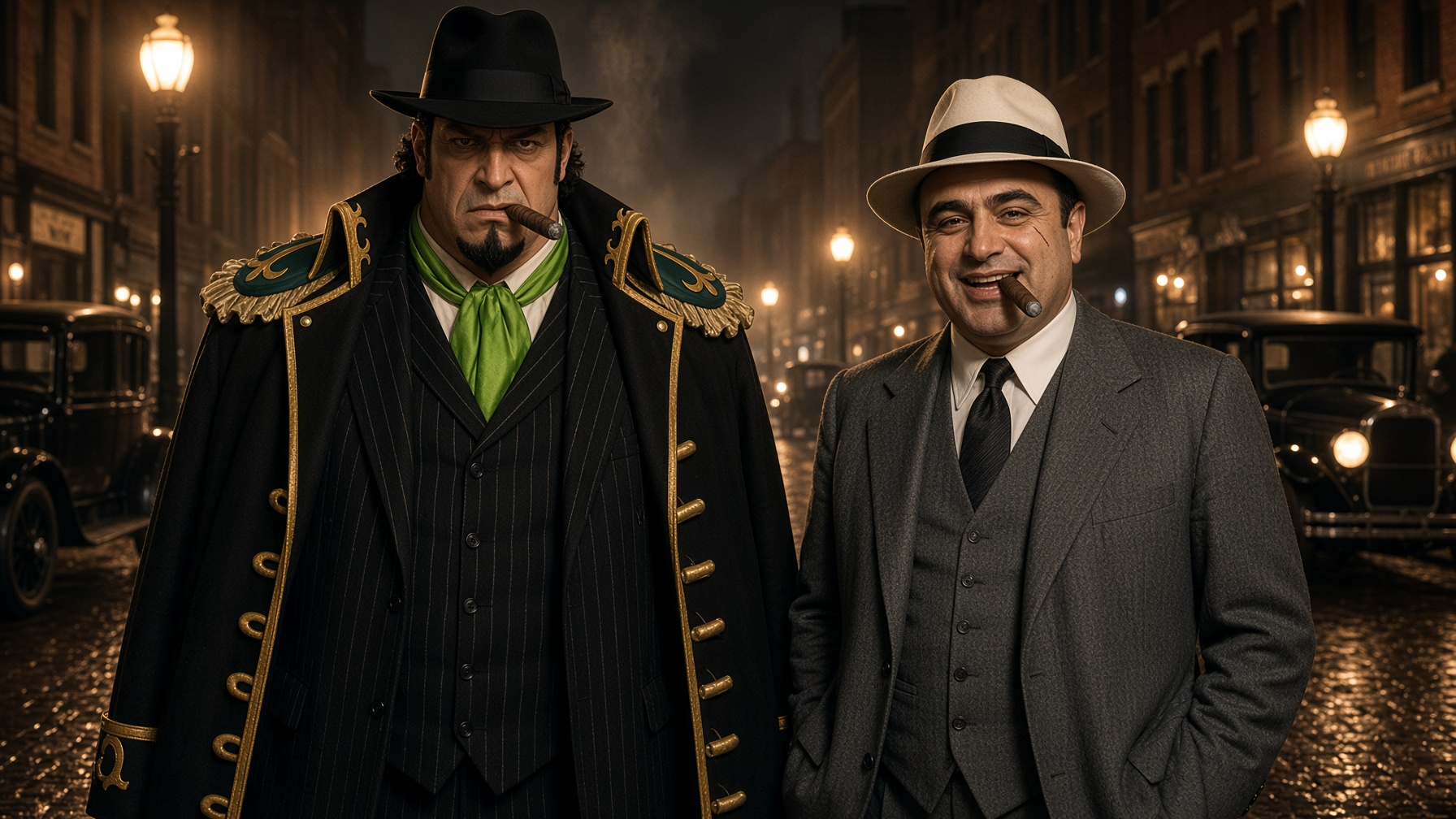
Capone Bege’s name comes from Al Capone and the English privateer William le Sauvage. In Volume 52’s SBS, a reader guessed Thomas Cavendish as the source, but Oda corrected that suggestion. Explaining only the profession of privateering while omitting the other part of the name leaves Bege’s origins incomplete.
Al Capone was a criminal organization boss active in twentieth-century Chicago. He was not a pirate operating at sea. He built his power through bootlegging and organized crime during Prohibition. Bege thus brings together a name from maritime history and the very different image of urban organized crime.
In this case, the connection is easy to recognize in the character’s appearance and behavior as well. His suit and hat, cigar, armed subordinates, and organization centered on a boss strongly evoke the Mafia as portrayed in popular culture. In the story, Bege comes from the gangs of West Blue and became known for his ruthless practice of targeting the leaders of rival organizations.
The Castle-Castle Fruit makes this organizational quality visible. Bege’s body contains his subordinates and weapons, and functions like a fortress when battle begins. I see this as an entertaining expansion of the Mafia boss image: an individual’s body becomes the organization’s base. Again, that does not mean Oda has personally stated that this was his reason for creating the ability.
9. Marshall D. Teach and the Real Blackbeard, Edward Teach
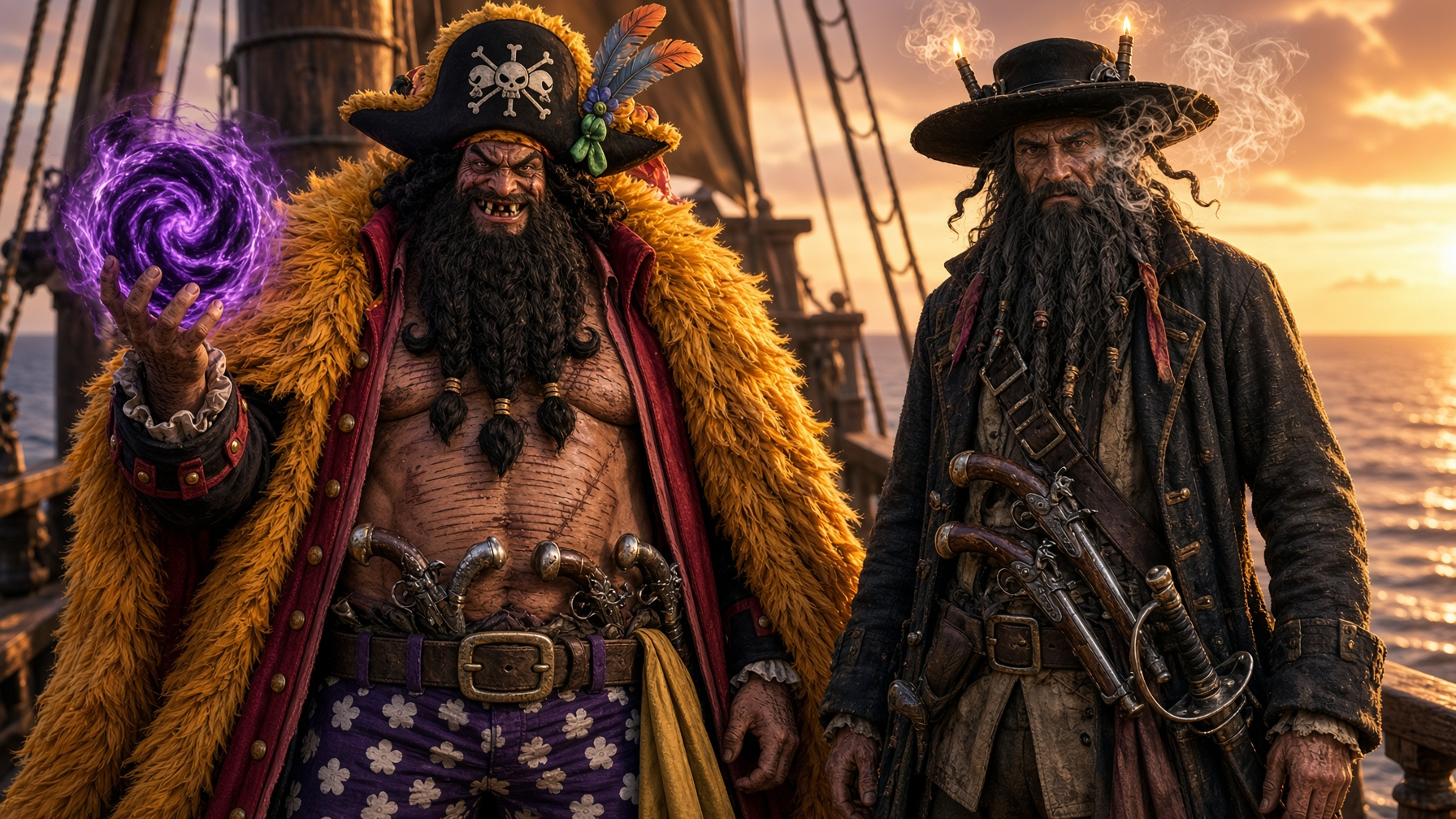
Marshall D. Teach inherits both Edward Teach’s name and the nickname Blackbeard. The historical figure’s name appears in forms including Edward Teach and Edward Thatch. His nickname, Blackbeard, is even more widely known. Among the figures discussed here, this is the clearest case of both a name and a defining nickname overlapping.
The real Blackbeard operated in the Caribbean and along North America’s Atlantic coast in the early eighteenth century. He captured a French slave ship, renamed it Queen Anne’s Revenge, and used the heavily armed vessel as his flagship. In 1718, he blockaded Charleston’s harbor; later that same year, he died fighting naval forces near Ocracoke.
He is also known for using a frightening appearance. Descriptions of his black beard, multiple pistols, and smoke rising from slow-burning fuses around his hat strongly influenced later pirate imagery. Still, contemporary accounts and later legends should not all be treated as equally reliable facts. The key idea is that his terrifying appearance was itself a weapon.
Teach in One Piece likewise builds his power through a reputation and strength that intimidate his opponents. He waits patiently for opportunities, obtains the abilities he needs, and exploits gaps in the existing order. I find that the threatening pirate image left by the historical Blackbeard fits strongly with Teach’s fictional portrayal.
10. Why Did Oda Give the New Generation of Pirates Historical Pirate Names?
What Oda directly confirmed is that he used real pirates’ names for several Supernovas. He has not fully explained whether every name contains a particular philosophy or a code for the character’s eventual fate. Rather than presenting one definitive answer about his motives, it is more accurate to examine the effects these choices create within the story.
I think one major effect is to bring the seas of different historical periods into a single work. A medieval mercenary pirate, a state-authorized privateer, a Caribbean female pirate, a Mediterranean military leader, and a South China Sea fleet commander all gather in the names of the same new generation. Adding a Chicago Mafia boss broadens the range of figures encompassed by the idea of a pirate even further.
We should therefore be cautious about looking up a historical pirate’s death and using it to decide a character’s fate. The execution of the real Kidd does not prove that One Piece’s Kid will meet the same end. Calling Nelson’s death at Trafalgar official foreshadowing of Law’s death likewise goes beyond the evidence.
These names are interesting because their real lives were not simply copied. Familiar history is borrowed, then layered with unexpected personalities, abilities, and choices. Rereading the names of One Piece’s Supernovas and the Worst Generation leaves a question that lasts longer than their origins: what kind of life might someone bearing the same pirate’s name choose upon an entirely different sea?