[ Movie Review] The Trojan War Was Not Helen’s Fault — How One Apple Thrown by an Uninvited Goddess Sparked a Ten-Year War

Combined tags for Naver visibility: causes of the Trojan War, golden apple, Eris, goddess of discord, to the fairest goddess, Judgment of Paris, wedding of Peleus and Thetis, Troy (2004), The Odyssey, Greek mythology, The Iliad, Greek and Roman mythology, the real reason for the Trojan War
We have been taught an overly simple version of the Trojan War: it happened because of the beautiful Helen, because Paris abducted her. But look a little deeper into the original myths, and a very different story emerges. The war’s true beginning was not on a battlefield, but at a peaceful wedding feast. Today, let’s trace its real origins from beginning to end.
01, Why Was Eris the Only Goddess Left Out of Peleus and Thetis’s Wedding?

In Greek mythology, the wedding of Peleus and Thetis is described as the grandest wedding in the history of Olympus. Peleus was a mortal hero, and Thetis was a sea goddess. Their marriage symbolically united the human and divine worlds, so all the gods, including Zeus, were invited. Yet there was one exception: Eris, the goddess of discord and strife.
Why was Eris alone left out? Because the gods knew that wherever she went, arguments followed. They deliberately excluded her, afraid that inviting the goddess of discord would spoil the celebration. But that turned out to be the most foolish decision of all. By leaving her out, they created an even greater conflict.
Doesn’t this sound familiar? At work, at school, or among friends, deliberately excluding someone is bound to make the tension erupt in another way. Bent on revenge for being left off the guest list, Eris slipped into the wedding and tossed in one of the most infamous gifts in history: the golden apple. The Trojan War began not with Helen, but with that one missing invitation.
Thetis, incidentally, would later become the mother of Achilles. The bride and groom were the parents of the greatest hero of the Trojan War. In that sense, their wedding held both the beginning and the end of the war within it.
02, “To the Fairest Goddess”: The Destructive Power of the Golden Apple’s Inscription
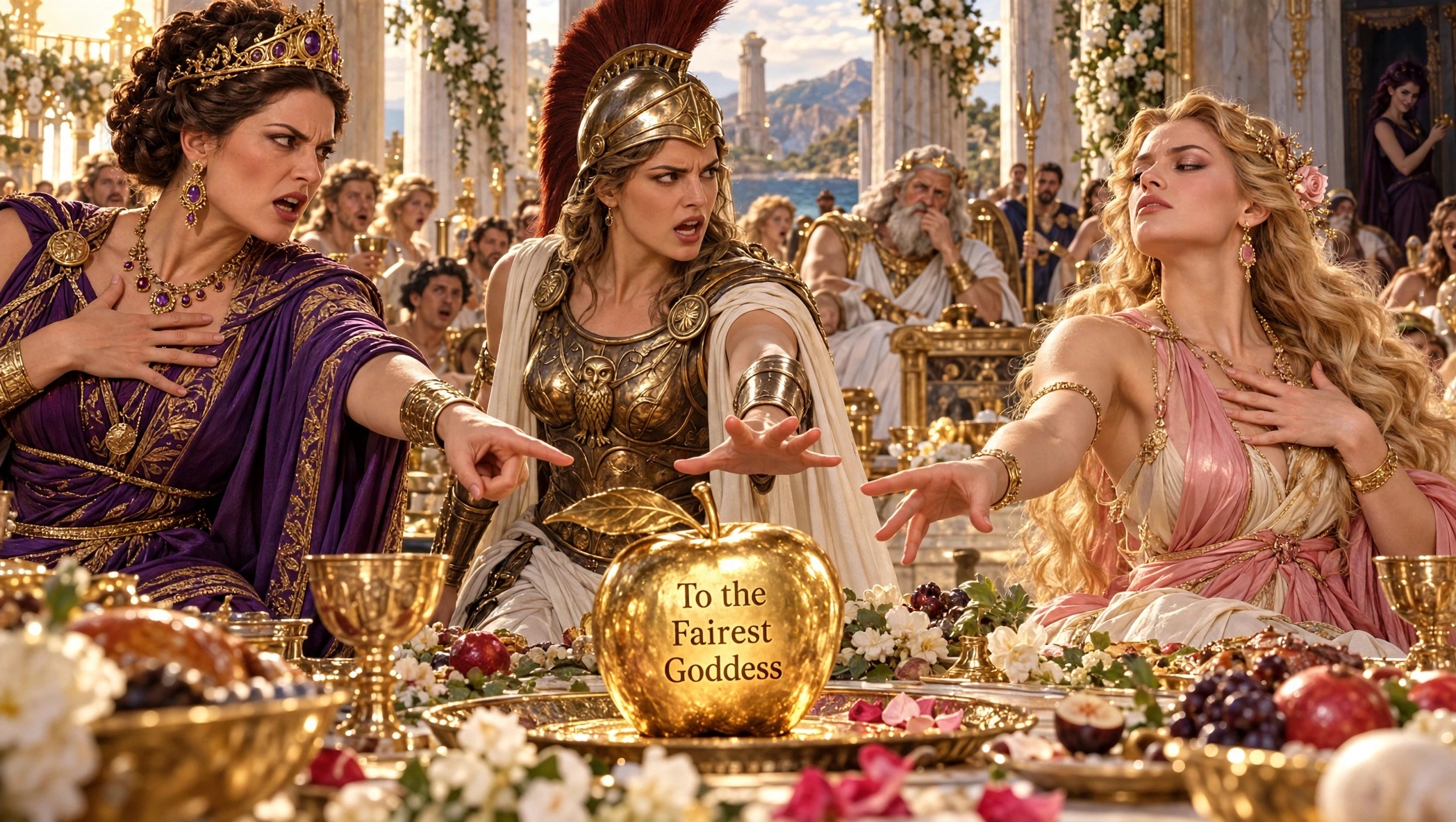
The golden apple Eris threw was no ordinary apple. Made of pure gold, it bore a single inscription: “To the fairest goddess.” That short phrase turned Olympus upside down.
Think about it. If a golden apple rolled into a wedding bearing the words “To the fairest goddess,” who would simply ignore it? Hera, Athena, and Aphrodite all stepped forward at once. Each insisted that she was the most beautiful.
The key phrase here is “To the fairest goddess.” On Naver, this inscription is associated with search terms such as “golden apple inscription,” “Eris’s apple inscription,” and “Kallisti.” In Greek, it is called Kallisti. That single word set the gods’ pride against one another.
This apple was more than a piece of fruit. It was a device designed to force comparison and jealousy. It created a contest with first place and no second prize. Only one of the three goddesses could claim it, ensuring that the other two would become enemies. It was a perfect act of manipulation. Eris never fought anyone herself; with one phrase, she made the greatest goddesses of Olympus fight each other. That is the destructive power of words. One seemingly small phrase set a ten-year war in motion.
03, Why Three Great Olympian Goddesses Let a Mortal Judge Them
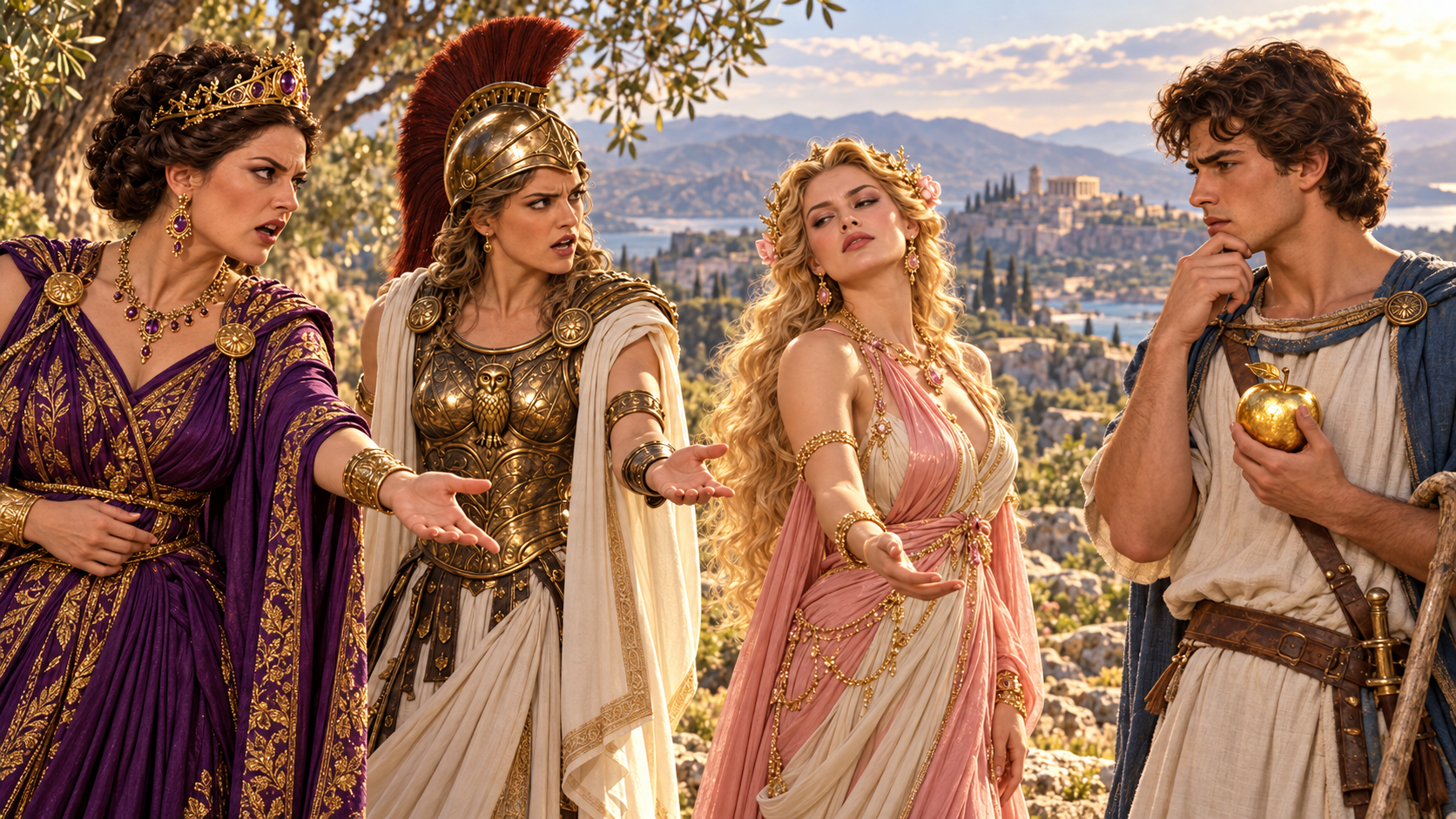
What happened next is even more astonishing. Zeus did not settle the dispute himself. Too afraid of the three goddesses, he passed the judgment on to a mortal. That mortal was Paris, prince of Troy.
Why Paris? He was the son of Priam, king of Troy, but a prophecy at his birth had declared that he would bring about Troy’s destruction. Ordered to be killed, he was abandoned, survived, and grew up as a shepherd. A prince by birth, he had nevertheless experienced life at the very bottom of the human world. Zeus decided to entrust the judgment to someone removed from power, someone who seemed likely to be fair.
But the three goddesses did not compete fairly. Each approached Paris privately and offered him a bribe. That is the essence of the Judgment of Paris.
Hera promised, “I will give you all the power in the world and make you king of Asia.” Athena offered, “I will give you the wisdom and strategy to win every war.” Aphrodite promised, “I will give you Helen, the most beautiful woman in the world, as your wife.”
Here we see human desire laid bare: power, honor, and love. Each goddess represented something people long for most. Paris chose love. At first glance, that may seem romantic, but it was a choice that ultimately led his country to ruin. It is a classic tragedy of what happens when one person is given too momentous a decision. The moment Zeus avoided his responsibility, Troy’s fate was sealed.
04, Why Troy (2004) Left Out This Scene—and What That Choice Cost
If you have seen Troy (2004), you will know that this scene is missing. The famous film starring Brad Pitt contains no golden apple, no Eris, and no contest among the three goddesses. Instead, it begins directly with Agamemnon assembling the Greek coalition and setting out for Troy.
Why leave it out? In an interview, director Wolfgang Petersen said that he wanted to remove the mythological elements and depict a realistic war driven by human politics and desire. In other words, he wanted the war to arise from human greed rather than the gods’ games. That is why Achilles is portrayed as an exceptionally strong man rather than a demigod.
But this choice came at an enormous cost. Viewers who had only seen the film were left without an understanding of the conflict’s underlying origins. It seemed as though everyone was simply fighting over Helen. That is why people familiar with the original myths call Troy (2004) “half the story of Troy.”
This difference leads directly to The Odyssey. Christopher Nolan’s film The Odyssey, by contrast, actively brings gods and monsters into the story. It is full of supernatural beings such as Polyphemus, Circe, and the Sirens. That is why watching The Odyssey after seeing only Troy (2004) can make the two worlds feel disconnected. One is a grounded drama with the gods removed; the other is a fantasy filled with gods and monsters. To understand the Trojan War fully, you need to know the golden apple episode that the film leaves out. Only then does the story connect all the way through to The Odyssey.
05, How Petty Jealousy Becomes a Ten-Year War: A Pattern in Myth
Finally, let’s consider why people are still searching for and talking about this story three thousand years later.
Greek mythology is a story about people, not just gods. Eris’s jealousy is the same jealousy we encounter in daily life: the hurt of not being invited, women competing for the title of the most beautiful, a young man torn between power and love who makes a foolish choice. All of this still happens in our society every day.
That is also why people search Naver, Google, Daum, and Yahoo for phrases such as “causes of the Trojan War,” “golden apple in Greek mythology,” “Eris, goddess of discord,” and “why the Judgment of Paris happened.” What interests them is not merely mythology, but the nature of human relationships.
Here is the pattern by which a little jealousy becomes a ten-year war.
First, a small act of exclusion leads to a great act of revenge. The seemingly minor decision not to invite Eris planted the seed of war.
Second, once people are forced into comparison, conflict follows. The words “To the fairest goddess” made comparison unavoidable.
Third, avoiding responsibility makes the tragedy worse. The moment Zeus passed the judgment on to Paris, the situation spiraled beyond control.
Fourth, the sweetest bribes are the most dangerous. Aphrodite’s offer was the most tempting, but it exacted the highest price.
The Trojan War happened not simply because one woman, Helen, was beautiful, but because these four dynamics of human desire exploded at once. The endless desires of three goddesses, and the foolish decision of one foolish man, came together to consume ten years in the flames of war.
In the next installment, we will explore how Paris, after making this foolish choice, came to meet Helen, and why Helen is portrayed differently in Troy and the original myths. In particular, we will take a closer look at why Helen appears as a Black woman in The Odyssey, including the underlying intentions behind Nolan’s decision.
If you found today’s post helpful, please subscribe to my Tistory blog and leave your questions in the comments. Your questions are the greatest inspiration for the next post.